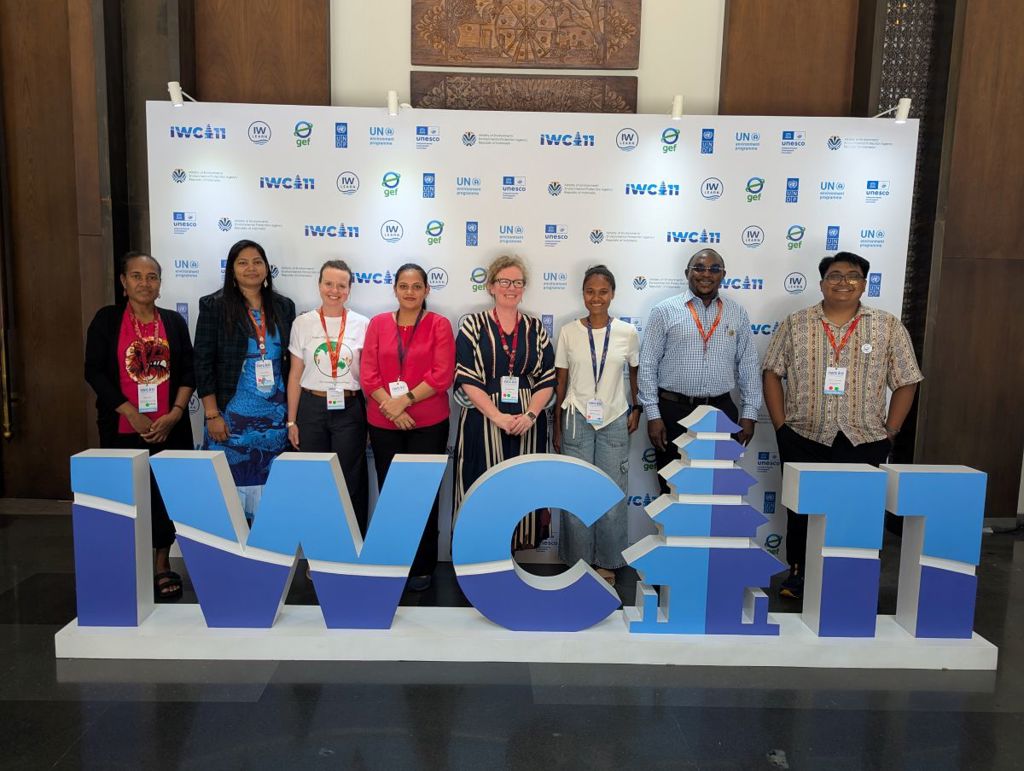
11th GEF International Waters Conference (IWC11)
At IWC11, the Coral Reef Rescue Project was represented by the University of Queensland, WWF-GEF, Reef Check Indonesia, Widlife Conservation Society (Fiji & Solomon Islands), Tanzania's Marine Parks and Reserves Unit and government ministries from partner countries.The conference theme, “Shared Waters, Transformative Solutions: Enabling Systems Change”, focused on turning portfolio learning into more durable and connected action.
For the Coral Reef Rescue Project, participation aimed to:
- Promote the Coral Reef Rescue Project.
- Share lessons from project implementation across Fiji, Indonesia, Madagascar, the Philippines, Solomon Islands, and Tanzania.
- Increase the visibility of climate-resilient coral reefs and the enabling conditions needed for long-term conservation.
- Exchange practical experience with other GEF International Waters projects and marine conservation partners.
- Contribute to discussions on project durability, inclusive governance, and adaptive management.
- Strengthen relationships that may support future collaboration and GEF-9 opportunities.
For Doris Kalamasaru of WCS Solomon Islands, attending IWC11 was as much about learning from others as it was about sharing the project's work.
"My first IWC! What sets this space apart was the learning and networking that extended beyond the conference venue. The technical site visit to the Jatiluwih Rice Terraces allowed me to not only hear but observe how traditional knowledge and community stewardship continue to guide water management, a powerful reminder that sustainable solutions are often rooted in local practice and collective action.
Connecting with people working across freshwater, coastal, and marine ecosystems during the conference also provided valuable insights into the diverse GEF-supported initiatives being implemented around the world. It was a unique opportunity to explore ideas that could be adapted and scaled for the Solomon Islands, not through replication alone, but by building on lessons learned to create solutions that are more relevant and effective in our context."
Doris Kalamasaru, WCS Solomon Islands
Exhibition booth: Coral Reef Rescue Project at IWC11
The Coral Reef Rescue Project exhibition showcased how GEF-supported action across Fiji, Indonesia, Madagascar, the Philippines, Solomon Islands, and Tanzania is strengthening the enabling conditions required for the long-term conservation and management of climate refuge coral reefs. The exhibition highlighted the project’s integrated approach, including free self-paced online courses, a decision support tool collating more than 70 data resources, and multi-sectoral National Hubs that support inclusive governance and planning.
It demonstrated efforts to increase investment opportunities for reef-positive businesses and livelihoods, while strengthening communication and awareness of the significance of climate refuge reefs. Together, these elements illustrated how collaborative, multisectoral approaches can build the capabilities, opportunities, and motivation needed to support future climate resilient reef conservation action. The booth was a practical space for project promotion, discussion, networking, and knowledge exchange.
At the exhibition booth, visitors explored the project through a country slideshow, an interactive coral quiz, demonstrations of its portal and free online courses, and conversations with in-country representatives and government focal points, while also building connections across the GEF International Waters community.

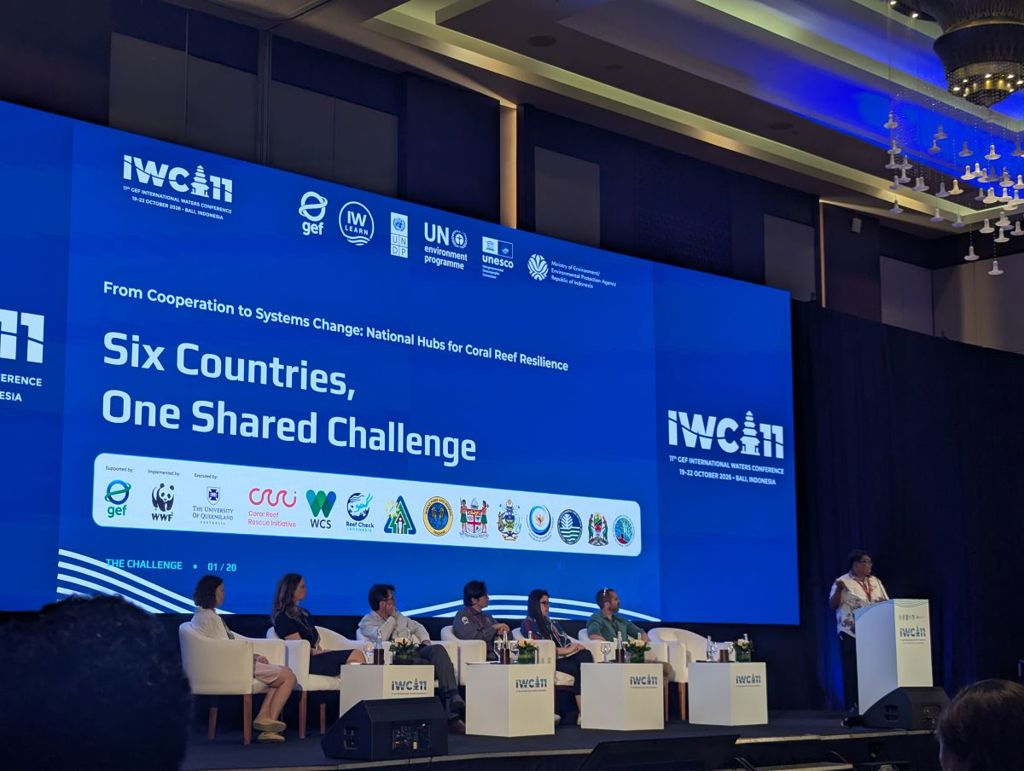
Pecha Kucha: From Cooperation to Systems Change: National Hubs for Coral Reef Resilience
The Coral Reef Rescue Project was selected as one of seven projects to present during the IW Innovation in Action Pecha Kucha plenary. The session showcased innovative solutions aligned with IWC11’s Day 3 theme, “Innovation in Action: from cooperation to systems change.”
Derta Prabuning of Reef Check Indonesia presented the project’s approach to National Hubs and National Action Plans, highlighting how these mechanisms can help turn collaboration between government, communities, technical partners, and other stakeholders into coordinated national action for coral reef resilience.The presentation followed the Pecha Kucha format of 20 slides shown for 20 seconds each, providing a concise seven-minute overview structured around the challenge, innovation, results, and lessons that could be adapted or replicated by other GEF International Waters projects.
Key focus areas:
- National Hubs as a mechanism for strengthening coordination and collaboration.
- National Action Plans as a pathway for translating collaboration into coordinated national action.
- Sharing the approach with the broader GEF International Waters community as an example that could inform or be adapted by other projects.
IWC11 Clinic: How do we choose where to conserve ecosystems and what does it take to make it work?
The Coral Reef Rescue Project and Blue Nature Alliance delivered a clinic entitled: How do we choose where to conserve ecosystems and what does it take to make it work?
The 90-minute clinic combined short project reflections with an interactive exercise focused on criteria, stakeholder perspectives, trade-offs, and the enabling conditions needed for lasting ecosystem outcomes.
- Participants compared how conservation geographies are selected and reviewed across different contexts.
- Discussions explored tensions between ecological value, feasibility, government priorities, community needs, funding opportunities, scale, and implementation readiness.
- Country examples highlighted the role of national and subnational stakeholder hubs, continuous engagement, community-led management, government commitment, and capacity building.
The clinic identified key enablers of transformative change:
- Inclusive partnerships that bring communities, traditional knowledge holders, government and scientists together
- Long-term support through good laws, skilled staff, committed champions and reliable funding
- Locally tailored approaches that protect ecosystems while supporting livelihoods
Women Ocean Guardians: Southeast Asia-Pacific-Australia
The Coral Reef Rescue Project also attended the invitation-only Women Ocean Guardians event held alongside IWC11. The event provided an opportunity to connect with women leaders working across ocean conservation and to exchange perspectives on strengthening women’s leadership, representation and participation in ocean governance.
Launched at the United Nations Ocean Conference in June 2025, the Women Ocean Guardians Initiative is a global public–private partnership that places women at the forefront of ocean conservation and the sustainable use of marine resources within formal decision-making systems. By strengthening their meaningful participation in governance processes, the Initiative seeks to transform ocean governance toward more resilient, inclusive and sustainable outcomes. The Initiative is convened by the Wildlife Conservation Society (WCS), Conservation International (CI) and the Global Environment Facility (GEF), in direct support of the Women Ocean Guardians themselves.

About the Coral Reef Rescue Project
The Coral Reef Rescue Project is a US$7 million project supported by the Global Environment Facility to build capacity and solutions that ensure the long-term survival of climate resilient coral reef ecosystems and the communities that depend on them. The project is implemented by the World Wildlife Fund and executed by The University of Queensland in partnership with Wildlife Conservation Society (Fiji, Madagascar, Solomon Islands), Yayasan Reef Check (Indonesia), Palawan Council for Sustainable Development (The Philippines) and Marine Parks and Reserves Unit (Tanzania).
Free Online Resources for Coral Reef Conservation
Complementing the work in each country, the GEF 7 CRR project has released four free online courses on coral reefs in three languages. These include Coral Reefs: Introduction to Challenges and Solutions, Coral Reefs: Sustainable Blue Economy, Coral Reefs: Data and Monitoring, and Coral Reefs: Climate Resilient Communities.
Alongside these courses, a new online decision support tool was created: Coral Reef Rescue Portal. This brings together over 70 existing coral reef datasets and resources in one easy-to-use, searchable platform.

.jpg)