Case studies from Indonesia: Real-time data and inclusive systems to support all voices in stakeholder engagement.
The ICRS is the world's leading conference dedicated to coral reef science, conservation, and management. This recent symposium provided Reef Check Indonesia with an opportunity to share their climate resilient coral reef work with a broad audience of researchers, practitioners, government representatives, non-governmental organisations, indigenous knowledge holders, students, and marine resource managers from around the world.
Derta Prabuning from Reef Check Indonesia reflected on a decade of collating and collecting coral reef data and the importance now of real-time decision making through the recently established National Coral Reef Hub. Fawzia Nasoetion, Coral Reef Rescue Project Coordinator, Reef Check Indonesia, highlighted how traditional knowledge and approaches are helping to sustain coral reefs through traditional reef closure practice and inclusive participation at national level.
Read more below about each Coral Reef Rescue Project presentation at ICRS.
Synopsis
“How locals make their voices heard through an inclusive system in Indonesian Coral Reef Hub” Fawzia Nasoetion, Coral Reef Rescue Project Coordinator.
Indonesia's archipelago contains approximately 41% of the world's climate-resilient coral reefs, making community-led conservation essential for their long-term protection.
Supported by the GEF-7 Coral Reef Rescue (CRR) Project, Reef Check Indonesia has developed national and sub-national Coral Reef Hubs within key bioclimatic regions to strengthen inclusive conservation and support local stewardship.
Across Indonesia, Indigenous Peoples and local communities hold valuable traditional knowledge and management systems, including Awig-awig in Bali and East Nusa Tenggara, and temporary reef closure practices such as Sasi and Hadi Mulung. These approaches reflect strong cultural, economic, and food security connections to coral reefs. The development of an innovative "buddy" system supports inclusive participation, strengthening local capacity, conservation ownership, and the resilience of both reefs and communities.
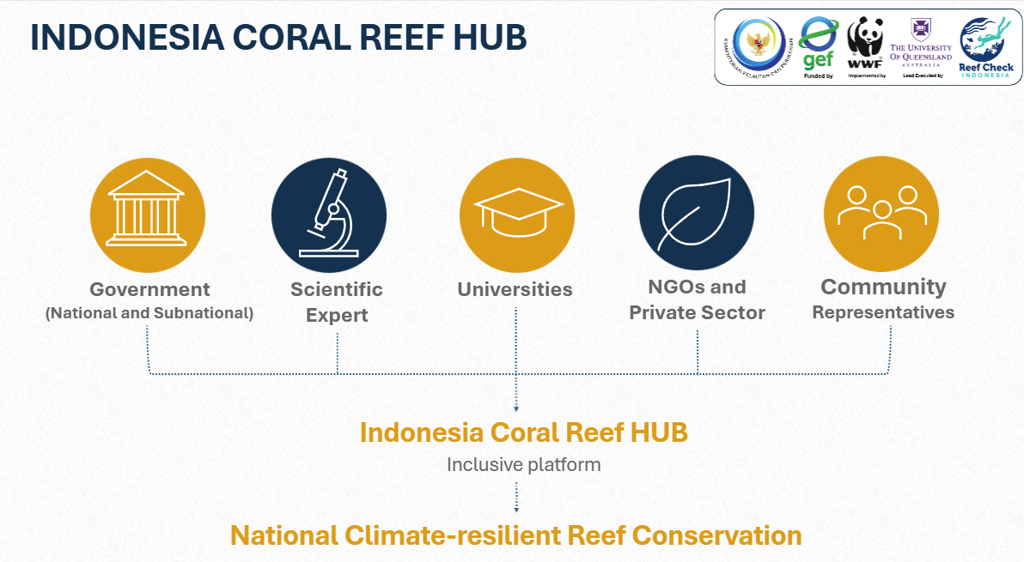
However, increasing pressures from coastal development, overfishing, and broader climate-related threats continue to degrade even highly resilient reef systems. The Coral Reef Hub model provides a platform for collaboration among communities, government agencies, NGOs, universities, and technical experts.
“What I valued most about ICRS was learning from people with so many different backgrounds and experiences. Seeing their unique project experiences made it clear to me that science and local knowledge belong together. When we bring both to the same table, we can make conservation decisions that are not only scientifically sound, but also meaningful and relevant to the communities who live closest to the reefs” - Fawzia Nasoetion, Coral Reef Rescue Project Coordinator, Reef Check Indonesia.
Synopsis
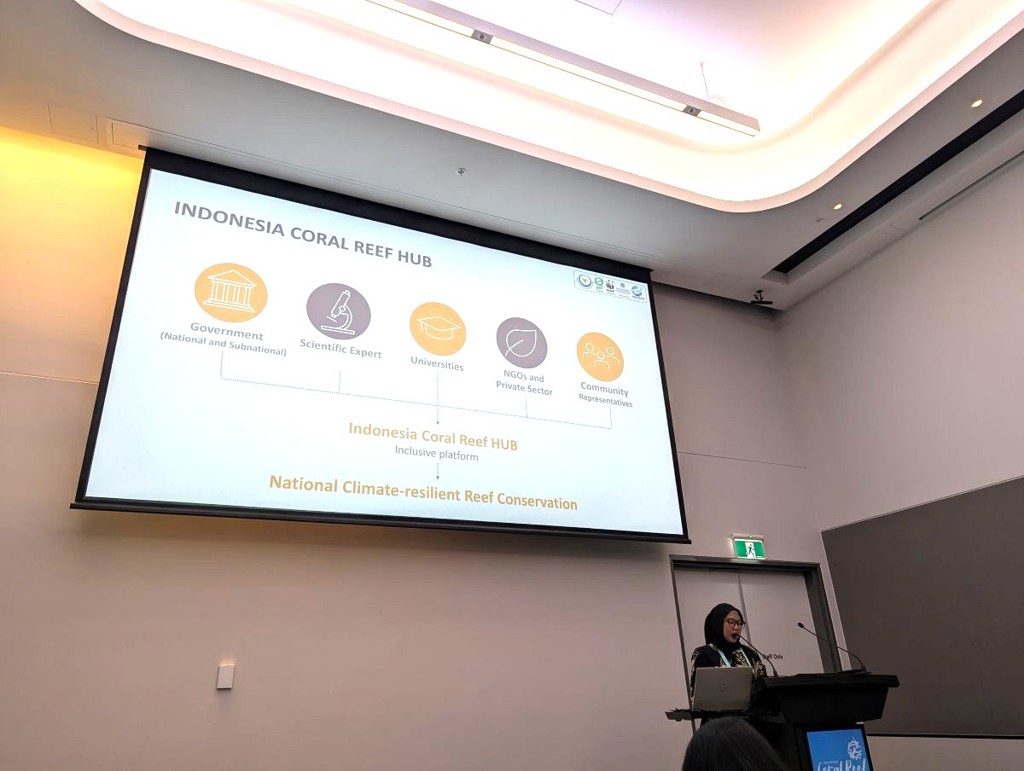
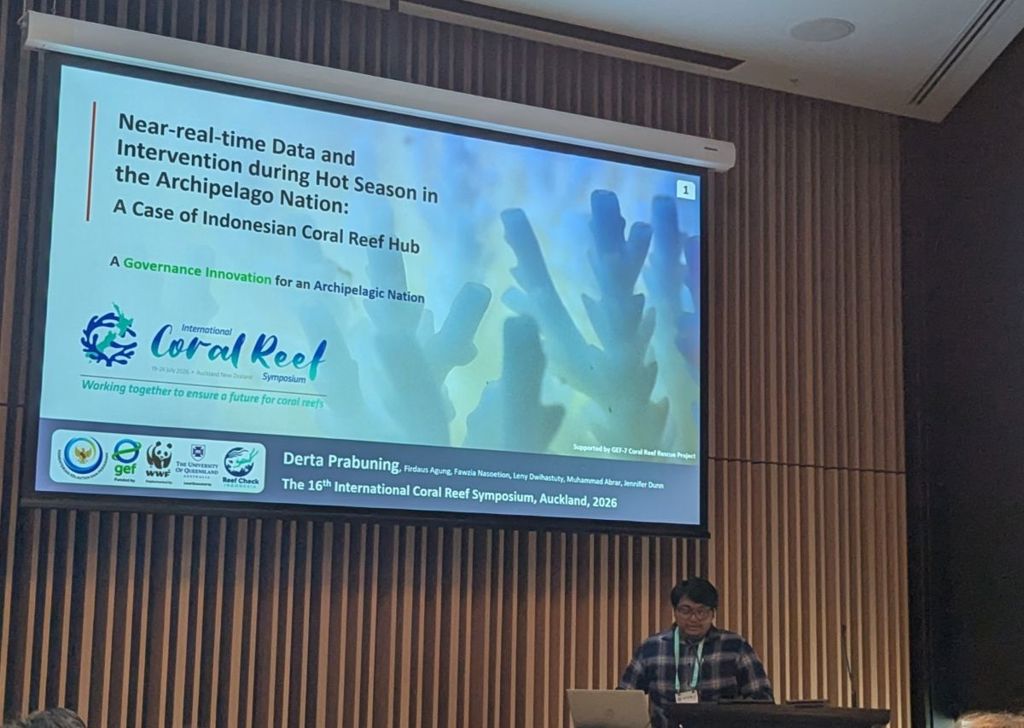
“Near-real-time data and intervention during hot season in Archipelago Nation: A case study of Indonesian Coral Reef Hub” Derta Prabuning, Reef Check Indonesia Director
“Ten years ago, we came to ICRS to share the story of building Indonesia’s coral bleaching monitoring network. Returning to ICRS this year, I realized that our challenge is no longer simply about collecting more data, but about connecting near-real-time monitoring with decision-making through the Coral Reef Hub — making sure information reaches the right people faster and leads to meaningful action on the ground” - Derta Prabuning, Reef Check Indonesia
Indonesia's vast coral reef systems present significant management challenges, particularly for near-real-time monitoring and rapid response during disturbance events.
Since its establishment in 2010, the Indonesian Coral Bleaching Network has grown to include around 1,000 volunteers from across the archipelago, including scientists, government agencies, NGOs, fishers, tourism operators, and local communities.
Supported by the GEF-7 Coral Reef Rescue (CRR) Project, the network is now integrated into the Indonesian Coral Reef Hub, a collaborative platform that provides technical support, coordination, and knowledge sharing among reef stakeholders. The Hub has evolved from a centralised model to a regional network, improving monitoring coverage across Indonesia's vast geography, including climate-resilient reef areas.
During the Fourth Global Coral Bleaching Event, the network demonstrated the value of decentralised coordination, social media communication, and scientific support in delivering timely alerts and information to marine protected area managers. The experience highlights the importance of investing in collaborative monitoring networks and digital tools to strengthen future reef conservation responses.
Latest Updates from Indonesia
About the Coral Reef Rescue Project
The Coral Reef Rescue Project is a US$7 million project supported by the Global Environment Facility to build capacity and solutions that ensure the long-term survival of climate resilient coral reef ecosystems and the communities that depend on them. The project is implemented by the World Wildlife Fund and executed by The University of Queensland in partnership with Wildlife Conservation Society (Fiji, Madagascar, Solomon Islands), Yayasan Reef Check (Indonesia), Palawan Council for Sustainable Development (Philippines) and Marine Parks and Reserves Unit (Tanzania).
Free Online Resources for Coral Reef Conservation
Complementing the work in each country, the GEF-7 CRR project has released free online courses on coral reefs. These include Coral Reefs: Introduction to Challenges and Solutions, Coral Reefs: Sustainable Blue Economy, Coral Reefs: Data and Monitoring, and Coral Reefs: Climate-Resilient Communities. Courses are available in English, Bahasa Indonesia, and French.
Alongside these courses, a new online decision support tool was created: Coral Reef Rescue Portal. This brings together over 70 existing coral reef datasets and resources in one easy-to-use, searchable platform.
.jpg)